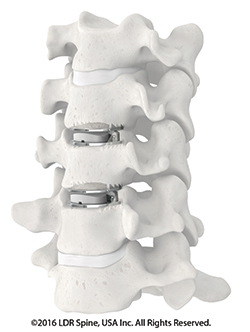
Mobi-C® Artificial Disc
A new advancement in spine surgery and spine implant technology
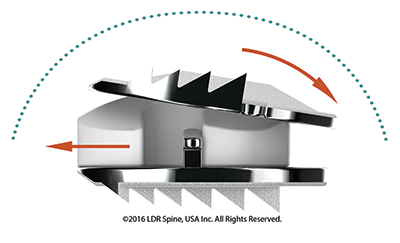
When a natural disc herniates or becomes badly degenerated, it loses its shock-absorbing ability, which can narrow the space between vertebrae. In fusion surgery, the damaged disc isn’t repaired but rather is removed and replaced with bone that restores the space between the vertebrae. However, this bone locks the vertebrae into place, which can then damage other discs above and below. Artificial discs are designed to retain the natural movement in the spine by duplicating the rotational function of a natural disc. Most artificial disc designs have plates that attach to the vertebrae and a rotational component that fits between these fixation plates.
About Artificial Disc Replacement
New research studies by the North American Spine Society — the most respected international society of spine surgeons — have shown that when a person has a herniated disc in the neck, and traditional fusion surgery is performed, there is an increased incidence of herniation at an adjacent segment. For these people, the newest FDA-approved artificial discs for the cervical spine can be of great benefit, explains Matthew Geck, MD, a board certified, fellowship trained orthopedic surgeon who has a practice focused exclusively on spine and scoliosis surgery..
“The downside of spinal fusion surgery is that locks two vertebrae in place,” Dr. Geck notes. “This in turn puts additional stress on discs above and below the affected area, which can lead to further disc herniation with the discs above and below the damaged disc. This process is called “adjacent segment disease” and it’s one of the main issues artificial discs were designed to address.”
The Benefits of Disc Replacement
The benefit of an artificial disc is that it retains the natural rotation of the vertebrae in the neck, which would otherwise be locked together in a traditional spine fusion surgery. By preserving motion, this lessens the risk that other adjacent discs might herniate as well.
Texas Spine & Scoliosis surgeons are trained in the use of a variety of artificial discs for the neck, but the Mobi-C disc was the first disc approved by the US Food and Drug Administration (FDA) for use at two levels in the neck. This can be of great benefit to those people with degenerative discs at more than one level in the neck and would otherwise need a fusion at the other level which in turn would restrict rotation.
“Artificial disc surgeries are motion-preserving non-fusion neck surgeries,” explains Dr. Geck. "These surgeries require specialized expertise in neck surgery because they involve a posterior approach (from the back of the neck), the use of tiny instruments and microsurgery. These minimally invasive, non-fusion approaches provide a faster return to activity."